Showing posts with label opinion. Show all posts

Wednesday, 16 January 2013

The blind leading the blind


If you think we should be optimistic about the future of written English, think again. The lost and the afraid who hope Google will lead them into the light may be doomed.
(Click images to see them bigger.)


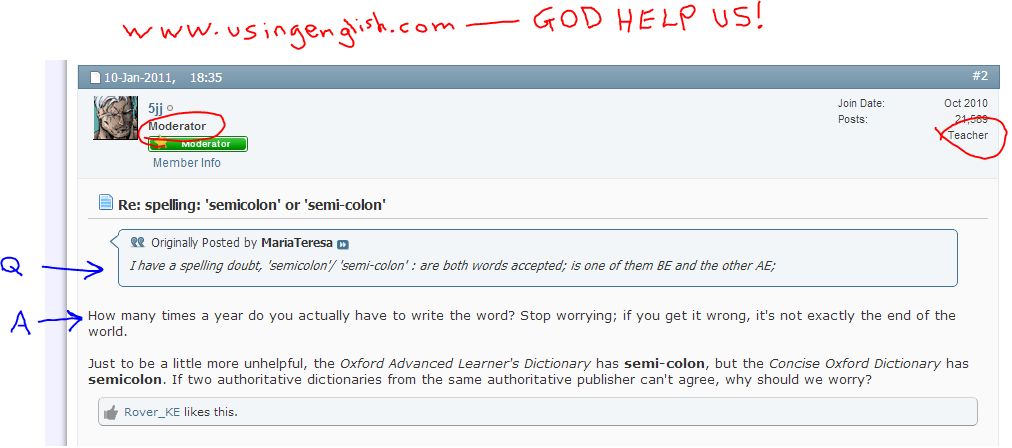
First we have "5jj", a (please God, self-styled) "teacher", moderating a web forum dedicated to helping people trying to learn English as a second language. MariaTeresa, the poor sap on the receiving end of 5jj's wisdom, reinforces my long-held view that foreigners learning my language tend to have more respect for it than do its native speakers. She posts an excellent question.
"I have a spelling doubt, 'semicolon'/ 'semi-colon' :
 are both words accepted; is one of them BE
[British English] and the other AE [American English]"

5jj's initial responses, like those of many insufferable show-offs who populate online help forums, are to pour scorn on the person asking for help, and explain why the question should not have been asked.
"How many times a year do you actually have to 
write the word? Stop worrying; if you get it
 wrong, it's not exactly the end of the world."

 Dear 5jj, if that's your attitude, why did you (allegedly) become a teacher, then set yourself up as moderator on this forum? Forget SOPA and PIPA. What the Internet most needs is a law making this patronising and unhelpful attitude a capital offence.

The original thread can be found here.


Meanwhile, at yourdictionary.com, a dimwit even more anonymous than "5jj" is sticking a knife into the definition of a sentence. Hey, at least the nameless one is well-meaning though, right? Here's his attempt to put the word subpoena into a sentence:
Subpoena witnesses to attend court in person to give evidence.

OK, so maybe I'm being a little harsh here. After all, if it's arguable that a string of words doesn't have to contain, say, an object, to qualify as a sentence, maybe it doesn't need a subject either. (That's a big maybe though - a big, bullshit-covered maybe!) But the point here is this: If your brief is to sit down and compose a sentence containing the word subpoena, the world's your oyster! If the reason for doing it is to help people to understand, why, oh why, would you go out of your way to deliver such a poor example of a sentence?  

The website has a contact form which invites users to submit comments and corrections. Perhaps this explains the situation - it's a wiki by another name.


The original page can be found here.


English (or perhaps every language) is vulnerable because native speakers often assume that being a native speaker means they're good at speaking (or writing) it, and/or that their opinions about it are inherently correct. The examples given above show otherwise.
The real point here is that the Internet's ability to give everyone a voice isn't always a Good Thing. Me, I'll take the piss when I see a mistake online, just as I'd nudge someone and point to a mistake in a book. And I'll do it in public, using the Web as a platform. It's my way (my only way!) of fighting back. But set myself up as an expert? Slap the word "Teacher" on my profile and swagger around a forum offering to bestow my expertise on lesser beings? I may be cocky, but I'm not that cocky. 


Tuesday, 15 January 2013

Two shades of grey?


I've just read a blog entry by author Max Barry. The entry is called Book Sadist and contains photographs of books literally coming apart at the seams. Max discusses the interesting distinction between the terms story and book - words we often use interchangeably. He observes that stories can be owned in ebook form, but that a certain tactile experience is absent from that form, as is the potential cumulative visual pleasure of having a shelf full of books. So far, so good.

But then Max proceeds to talk about two types of book owner. Just to be clear on this point, I must stress that Max implicitly states there are only these two extremes, describing "people who have treated books with reverence, laminating their covers, turning their pages with care, and never cracking their spines" then continuing "And there have been people like me." From a strictly logical standpoint, this doesn't claim every book owner is one of these types, but it's clear from the tone that this is what Max believes.

Max then proudly displays pictures to illustrate what a real story-lover's books look like. He says he doesn't deliberately destroy books, and I believe him. What I don't buy into is the idea that a tatty book shows that the story is loved or that a pristine one shows the opposite. (Max gives the clear impression that if you ask him to autograph your copy of his next book and it's not in tatters, he'll know you don't think much of it.)

I'd like to suggest that viewing the book-owning public as comprised of two extremes is a bit naive. Maybe there are uptight people to whom a book is merely a bookshelf decoration. And, as Max's post shows, there's at least one person incapable of reading a book several times without destroying the thing. But then there's the vast majority: Normal book lovers (in Max's terms, story lovers - far out, man!) who enjoy the stories just as much as anyone (yes, Max, including you!), yet have enough self-control to read and re-read without shredding the pages or dismantling the spine. (As an aside, one has to wonder why someone who didn't mean to read a book over and over would bother to laminate its cover. I laminate books precisely because I intend to read them a lot.)

Max's attitude is curiously at odds with his behaviour. He seems to claim the intellectual or moral high ground, valuing the meaning and emotion of a story above the mundane object which stores it. But his pride in the battle-scarred condition of his books betrays at least some degree of materialism, albeit of an unconventional form.

I just want to come back to the subject of ebooks before I sign off. While we're all busy patting ourselves on the back for valuing content over medium, Amazon is laughing all the way to the bank - or at least getting ready to. When they're old enough to appreciate them, my sons can have my favourite books. And if they don't love the stories as much as I did, they can give the books away - possibly to a charity shop, to be bought by a complete stranger who might but might not have enough money for an ereader.

But the books can only find their way into the lives of these people...

  • IF they haven't disintegrated through needless abuse. And yes, Max's books have been abused. I have books (ok, ok, stories!) I've read just as many times, and (sit down for this, Max!) loved just as much, which are still in a decent state.
  • IF they exist in physical form at all. There are many seductive arguments for buying ebooks, from tree-saving, to weight-saving. But valuing story over medium isn't one of the best. And even the (sometimes) lower cover price isn't the be-all-end-all of cost the to reading public. A book I buy for my Kindle can't be passed, via a second-hand shop or charity shop, into the hands of strangers who share my love of fiction. This is the bit Amazon and its like find so amusing. The reading public, as a whole, must buy, buy, and re-buy these books. (oops, sorry - "stories", man.) As an author, I suppose I ought to side with the corporation on this particular issue. I ought to be citing that front-matter small-print no one ever reads - the bit that says "this book shall not be lent, resold, etc". And I do love ebooks*. But I'm a story lover at heart, and story - as Max rightly says - trumps medium. That's something we seem to forget in our headlong rush to the sunny slopes of Mt. Technology. 
One thing I think Max and I share is a bewildered amusement at anyone who'd buy a book simply because it looked good on the shelf. Or, worse, so that it would make the shelf's owner look good. On an intellectual level I can understand the behaviour, but - as Max wrote of people taking care of stuff, I have to admit I don't quite get it. 


* Mostly because my weak old eyes can see 'em better! 


Friday, 11 January 2013

Less voodoo, more rocket science


Thanks to a tweet by Joanna Rossiter, I've just seen this (rather dated) piece in The Spectator, by established novelist Allan Massie, and feel the time has come to start venting spleen in this-'ere blog.

Like many others, Mr Massie pours scorn on the idea that creative writing is something that can or should be taught. I don't agree with him.


Just to be clear: I'm not defending my OU diploma. (At least, not in the way the secretly dismayed owner of an overpriced-but-sexy computer or mobile phone will defend their purchase with increasingly evangelical fervour rather than admit they pissed their money away on tat that doesn't work properly.) For the umpteenth time, I'll go on the record and say The Open University's creative writing courses were lacking. (Particularly A363, the "Advanced" one. In the case of A363, "lacking" is standing in for "shite"!) The peer contact and support, together with (postcode lottery permitting) tutor encouragement was great - almost worth the course fees on their own if I'm honest. But the actual courses (sorry, "modules"!) compare very poorly with the books on my list of Recommended Creative Writing Books, which can be bought in its entirety for £120 (about a third of the cost of each OU course when I did them; not even a tenth of their current prices). If you're prepared to even entertain the idea that I may be right making this comparison, then, with careful shopping, you could probably get the entire list for well under £50 - well worth a flutter? I have digressed a bit, but hope I've convinced you that I'm no university fanboy.


Whether or not creative writing can be taught, it's undeniable that it can be appraised. Subjective though the process may be, it wouldn't be too difficult to find a body of opinion holding that, say, Jane Austen's handling of character motivation is pretty bloody nifty. (Or that reading Dr Seuss is more fun than reading Miss Austen.) Bear with me - I am going somewhere with this, honest! Whether the literary merits of my own own writing are closer to Pride and Prejudice, The Cat in the Hat, or a note Tommy Robinson left out for his milkman, everyone who's read it, friends and strangers, siblings and spouse, would tell you it's better now than it used to be. And here's the thing: It's not down to some slippery concept like "experience"; I've lived a shamefully sheltered life in many ways (especially in terms of relationships) and did BUGGER ALL writing between the utter crap I wrote before my twenty-year textbook orgy and the crap I write now. Go figure!


For me, even hallowed stuff like "inspiration" turned out to be something that could be achieved (though not, I hasten to add, with ease) by dint of adopting the right attitude and techniques. Hell, many established authors admit as much! Douglas Adams modestly attributed his greatest success to a flash of inspiration but was quick to point out that it was a one-off. Ideas don't usually come to you while you're lying in a field, he said, "you just have to sit there and think of the little bastards."

It's understandable that some who (think they) are "naturally" good at writing should wish their craft to be unteachable. They never come up with any reason that any aspect of their arcane vocation is beyond the reach of mortals - unless you count an "It just is!" stance as reason. They hate the idea that the pedestal upon which they sit might have room for more. That is all.


Friday, 10 August 2012

A363 end-of-course feedback (Or, "Mr Angry Goes to Town")

Today I took advantage of the opportunity to give feedback on A363, using an online questionnaire. Highlights from my responses are below. Apologies for typos, etc. I was "typing angry", lol.


  • [33] The guidance in the Assignment Booklet seemed to have been written to test us more than guide us. The advice for TMA 03 referenced at least two other sources of advice, one of which used terms not sufficiently explained - least of all in the main course book. I spent an entire day simply collating the scattered bits of advice and fragmented TMA requirements, and trying to draw a single coherent assignment from it. It was hard work, but I did it in the end. I firmly believe that it was this, plus a ruthlessly tactical approach to my choice of discussion material, which earned me a score higher than most of those I talked to. Seems a bit wrong to me.

  • [39] Three of the six TMAs were returned to us significantly later than the expected two-week deadline. In the case of TMA 06, this directly and adversely affected my own EMA performance (and that of MANY of my peers) because we were supposed to use TMA 06 tutor feedback to guide us. We plan to write to the appropriate PVC about this.

  • [49] The only significant benefit I had from this course was peer support. That aside, I could have taken the course fee, spent half of it on a short holiday, spent half the remainder on booze, then spent half of what was left on creative writing books from Amazon, and been in a better position to develop my skills. I'd have beer money too. (In fact, I have said this many times to peers and to prospective enrolees. I have even created a "List" on Amazon which I refer potential A363 victims to.) The inadequacy of this course was quite staggering.

  • [Forgot to record question number - was to do with what I'd like to have seen I think.] More nitty-gritty creative writing technique, and less airy-fairy useless stuff. If you must try to take it to a higher plane, refer more to Campbell's mythic structure and material of similar repute.

  • [60] The module has failed to contribute to the achievement of my overall study goals.  Although I tried to link A363 and A215 to the E25 Diploma in Literature and Creative Writing a long time ago, I have not been awarded that diploma. Apparently the OU has decided not to issue this diploma any more. It would be irritating enough to do the exact same work as my predecessors and not be awarded the same diploma, but some of my own A363 cohort HAVE been awarded the diploma this past week! When I checked my qualification planner I found that A215 has been removed. The official statement of progress states that the (only) reason I do not have the diploma is lack of points. The official statement does not mention the award being defunct. Be assured that well over 100 other students are currently discussing this issue on Facebook and we all expect the OU to do the right thing. This is just the latest in a series of spectacular screw-ups, starting with absentee tutors, and including inexcusably and disastrously late returns of TMAs. I feel a letter to the national press coming on.


  • Sadly, the threatened letters to a Pro Vice-Chancellor and national newspaper were never written. Once again, the OU got away with very shoddy service because of what I call TFFT Syndrome. Students are so relieved to see the back of a course that their resolve to make a fuss about its quality wanes. We should have complained, but didn't. Shame on us. 


    Sunday, 1 July 2012

    Read all about it

    Some of my fellow students enjoyed The Open University's course in "Advanced creative writing", but, if the posts in the dedicated Facebook group were anything to go by, many were disappointed. In fact, a significant minority felt short-changed by a course which simply didn't do what it said on the tin.

    I'm somewhere in the middle, but only because it's the average between two extreme positions. I loved the mutual support thing with my fellow students, and my tutor was fun (if slow at marking) but I despise the course book and those responsible for it. More than once I've ended up angrily claiming that one could spend the course fee on a nice little holiday and use the change buying thirteen books from Amazon which would outshine A363's Big Blue Book.  When challenged to put my URL where my mouth was, I'd often already moved on to another whinge in another thread, so here it is... click here: My recommended reading list.

    I'll write detailed reviews of some of the most important books on that page in due course, but for now, here's a very quick mention for my top three:

    • The Writer's Journey - absolutely indispensable. If you aren't familiar with the concepts in this book, you risk severely handicapping yourself from the start. 
    • Getting into Character - promises "secrets from method acting that can be used by writers" and it delivers. In spades. 
    • The Nuts and Bolts of Writing - To be honest, there are many books of this sort, but I have a soft spot for the much-missed Michael Legat, as it was one of his very accessible books that first made me realise (a) I might not have been born a literary giant and (b) there might be something I could do about it.

    If you only read three creative writing books in your life,
    you could choose far worse ones than these.


    BONUS RECOMMENDATION 
    After seeing it mentioned in various corners of the Internet, I took a chance on Creative Writing for Advanced College Classes by George Williams. Published in 1954, it needs allowances made for some old-fashioned (and entirely incidental) attitudes. But it's solid gold. Its first half in particular is packed with tips of the goodness-I've-been-writing-like-a-turd variety. Sadly, the going rate on Amazon is about thirty quid, but - if you can afford it - it's an excellent follow-up read to the Legat book mentioned above.